
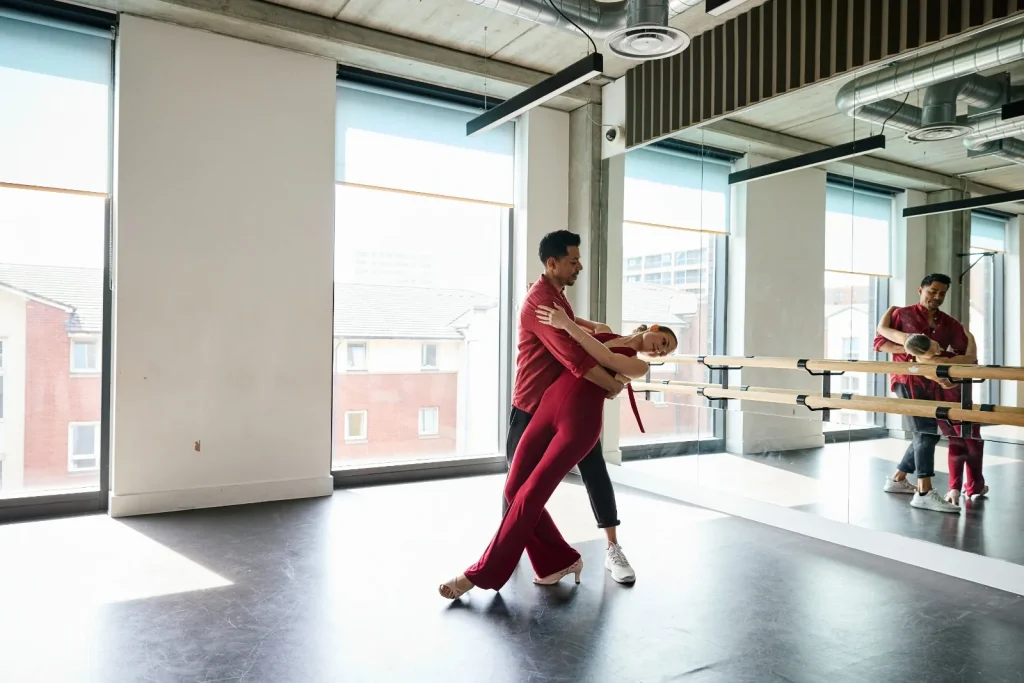
Learning bachata from home is now accessible to everyone. Thanks to online resources, you can master basic steps and advanced figures at your own pace.
Educational videos offer unparalleled flexibility. You choose when and where to practice, without scheduling constraints.
Channels such as Dance at Home or Dance Classes Gold Coast offer lessons suitable for every level. More than 25,000 lessons have been delivered since 2018, demonstrating this worldwide enthusiasm.
Whether you are a beginner or an experienced dancer, these tools help you improve quickly. Online learning is becoming an ideal way to refine your style.
The origins and evolution of bachata
Bachata has its roots in the vibrant history of the Dominican Republic. Once marginalized, this musical genre is now celebrated for its authenticity and emotion.
Origins in the Dominican Republic
Emerging in the 1960s, bachata developed in the Dominican countryside. It arose after the end of the Trujillo dictatorship, which freed artistic expression.
The first artists used simple instruments: Spanish guitar and güira. Their lyrics told stories about love and everyday life.
Musical influences: bolero and merengue
Cuban bolero and Dominican merengue profoundly shaped this style. Their fusion with African rhythms created a unique sound.
This cultural blend explains the richness of its melodies and associated dance steps.
Worldwide popularization
Long regarded as “lower-class” music, bachata gained recognition in the 1990s. Artists such as Juan Luis Guerra introduced it to international audiences.
Today, more than 500 festivals are dedicated to it each year. Modern fusions with pop or R&B, such as those by Romeo Santos, are broadening its audience.
| Event | Period | Impact |
|---|---|---|
| Birth | 1960s | Rural development |
| Recognition | 1990s | Legitimization |
| UNESCO | 2019 | Cultural heritage |
The different bachata styles to know
Bachata comes in several styles, each with its own characteristics. These variations reflect its geographical and cultural evolution. For dancers, understanding these differences is essential when choosing the style that suits their personality.

Traditional Dominican bachata
This style draws on the original characteristics. Intricate footwork and connection with the floor take center stage. The tempo is fast, making it ideal for those who enjoy energetic dancing.
Partners maintain a moderate distance. Their hips move naturally, without exaggeration.
Bachata moderna
Popularized by duos such as Ataca & La Alemana, it incorporates elements of salsa and tango. The rhythm is slower, allowing dancers to perform technical figures.
Clothing focuses on comfort, with flat shoes providing greater stability.
Sensual bachata
Created in Spain, this version emphasizes pronounced body waves. Sensual bachata styles now account for 68% of lessons.
Korke & Judith are its leading figures worldwide. High heels are often recommended to accentuate the movements.
Tip: try each style to identify the one that inspires you most: Dominican for technique, moderna for creativity, and sensual for expressiveness.
The fundamental elements of bachata
The essence of this practice lies in the harmony between music and movement. These foundations transform a simple sequence of steps into a genuine physical dialogue.
The characteristic musical rhythm
The 4/4 structure, with an accent on the 4th beat, creates a recognizable pulse. Count “1-2-3-tap” to synchronize your movements.
Beginners often overlook the offbeat. A comprehensive guide recommends listening to the music first without moving.
The connection between partners
Leading is primarily done through the torso and hands. Too much pressure disrupts fluidity; too little makes the figures imprecise.
Avoid stiffness in the shoulders. This common mistake limits the expression of movement.
Hip movement
Fifteen minutes of daily isolation exercises will considerably improve your technique. Use a mirror to correct your alignment.
Weighted belts heighten body awareness. Combine them with progressively challenging playlists.
| Exercise | Duration | Benefit |
|---|---|---|
| Hip circles | 5 min | Mobility |
| Weight transfers | 7 min | Balance |
| Body waves | 3 min | Fluidity |
These elements form an inseparable trio. Mastering them brings the poetry of the moving body to life.
Benefits of learning bachata online
Discover why online learning is revolutionizing the way this dance is practiced. Digital platforms combine freedom with effectiveness and adapt to every schedule.

Flexible scheduling
You no longer need to follow fixed time slots. Learn at midnight or dawn, whenever you like. Thanks to this personalized consistency, 73% of users reach an intermediate level within six months.
Features such as slow-motion video and replay loops help you master every detail. They are ideal for people who work irregular hours.
Learning at your own pace
Unlike group lessons, you do not experience the pressure of keeping up with others. Review a figure 20 times if necessary, without embarrassment.
“I learned for my wedding in three months thanks to replays,” says Sophie, 32. Apps such as Steezy and DanceForth track your progress step by step.
Saving time and money
No more traveling to a studio. Practice from home while saving up to 80% compared with in-person lessons.
| Option | Monthly cost | Benefit |
|---|---|---|
| Online subscription | €20 | Unlimited access |
| Private lessons | €250 (5 hours) | Personalization |
These advantages make online lessons an essential practice. The savings benefit both your wallet and your progress.
Basic steps for getting started with bachata
Mastering the fundamentals opens the door to a rewarding practice. After 20 hours of training, beginners generally learn the essential sequences.

The basic three-step movement
This universal step relies on precise weight distribution: 50% on the left foot, 50% on the right foot, then 100% during the “tap.” Use a metronome set to 100 BPM to synchronize your movement.
A common mistake? Forgetting the complete transfer on the 4th beat. Place your hands on a chair to check your balance.
The toe tap
This dynamic step requires coordination between the hands and feet. Practice to Aventura’s “Obsesión”: point your right foot when the voice rises.
To avoid losing your balance, bend the opposite knee slightly. Your hips remain stable while your toe brushes the floor.
The side step
Mark lines on the floor with adhesive tape. Move by crossing alternately in front of and behind this visual guide.
Your choreography will become more precise with three 25-minute sessions per week. Alternate between exercises facing the mirror and with your eyes closed to develop muscle memory.
| Exercise | Frequency | Goal |
|---|---|---|
| Weight transfers | 5 min/day | Stability |
| Musical toe taps | Twice/week | Rhythm |
| Monthly checklist | 1 assessment | Progress |
These fundamentals form the foundation of your learning. Record your achievements in a training journal to measure your progress.
Online bachata dancing: video tutorials to improve
Choosing appropriate resources speeds up your progress. Online videos offer a wide range of methods, but they are not all equally effective.
Criteria for selecting an effective tutorial
Favor content with:
- Multiple camera angles (front, side, overhead)
- Clear verbal explanations and slow demonstrations
- Content divided by level (beginner to advanced)
Avoid tutorials without structure or with poor lighting. A good lesson always provides progressive exercises.
Leading YouTube channels
Some of the most popular include:
| Channel | Subscribers | Specialty |
|---|---|---|
| Bachata Academy | 500K | Pure technique |
| Sensual Movement | 320K | Fluidity and style |
Organizing your sessions
A typical routine includes:
- Warm-up (10 min)
- Specific technique (20 min)
- Sequence (15 min)
The MirrorCam app helps correct posture. Record your progress each week to adjust your pace.
Intermediate movements to master
Advancing to the next level requires perfect execution of key elements. These movements add style and variety to your choreography.

The basic turn
The key to a fluid turn lies in the spotting technique. Focus on a point in front of you and return your gaze to it quickly after the rotation.
Practice without a partner first. Begin with half turns before moving on to full rotations.
The cross-body lead
This elegant movement requires good coordination. The leader must anticipate the change of direction to avoid collisions.
Practice slowly while counting aloud. Gradually increase your speed to songs such as “Eres Mía.”
Dips
Safety comes first in these spectacular figures. Always maintain:
- A straight back
- Slightly bent knees
- A firm yet relaxed hold
Avoid these common mistakes:
- Tilting your head backward
- Forgetting to protect the neck
- Forcing the range of motion
| Exercise | Duration | Goal |
|---|---|---|
| Turns with spotting | 5 min/day | Fluidity |
| Assisted dips | 3 times/week | Confidence |
Always adapt the movements to your partner’s height. Clear communication ensures a safe and enjoyable practice for all dancers.
Creating a home practice space
Transforming a corner of your home into a dance studio is easier than it seems. A well-organized space enhances your practice and confidence.
Optimal setup
Allow at least 2 × 2 meters of open space. This lets you perform the movements without restriction. Here are the key elements:
- Flooring: hardwood for sliding or dense carpet for shock absorption
- Walls: acoustic covering reduces noise disturbance
- Lighting: adjustable 3,500 K LEDs for perfect visibility
A budget of €300 to €500 is enough for a complete setup. Prioritize flooring quality, which is essential for protecting your joints.
Suitable clothing and footwear
Your body needs freedom of movement. Choose:
- Breathable tops made from stretch fabric
- Leggings or flexible pants without uncomfortable seams
- Professional shoes such as Bailarinas Pro or Salsalove
Clean your shoes with a microfiber cloth after every use. Clean soles provide better grip.
Using the mirror
Position it at a 45° angle to your dancing axis. This position reveals posture problems. Three key uses:
| Goal | Distance | Duration |
|---|---|---|
| Technical correction | 1 meter | 15 min/session |
| Overall analysis | 2 meters | 5 min |
Alternating exercises with and without a mirror develops your spatial awareness. Your progress will quickly become visible.
Additional resources for improving
Develop your potential with tools tailored to every stage of your learning. These resources transform your practice into a rich and varied experience.
Essential mobile apps
Three apps stand out for Latin dances:
- Bachata Rhythm Trainer: a scoring system that analyzes your synchronization with the rhythm
- Steezy: progressive lessons with integrated video feedback
- Dance Mirror: captures your movements in 3D to correct posture
Use them for 15 minutes a day to see noticeable results within three weeks.
Targeted music playlists
The Spotify playlist “Bachata Evolution” categorizes 800 tracks according to:
- Rhythmic complexity
- Speed (BPM)
- Style (traditional, fusion, urban)
It is ideal for adapting your lessons to your level. Add your favorite tracks for personalized progress.
Active exchange networks
Join groups such as Bachata Worldwide (200K members) to benefit from:
| Benefit | Frequency |
|---|---|
| Technical advice | 50 posts/day |
| TikTok challenges | Weekly #bachatachallenge |
Sharing experiences boosts motivation. Take part in the virtual congresses listed in the community calendar.
Conclusion
Combining online practice with workshops speeds up mastery. Like Léa, who gained confidence in three months with this blended method, you can transform your progress.
Take our “30 days of dance” challenge to measure your improvement. Virtual reality, soon to be integrated into lessons, will make learning even more immersive.
Final tip: ten minutes every day is better than one long, irregular session. The important thing is to enjoy moving!