
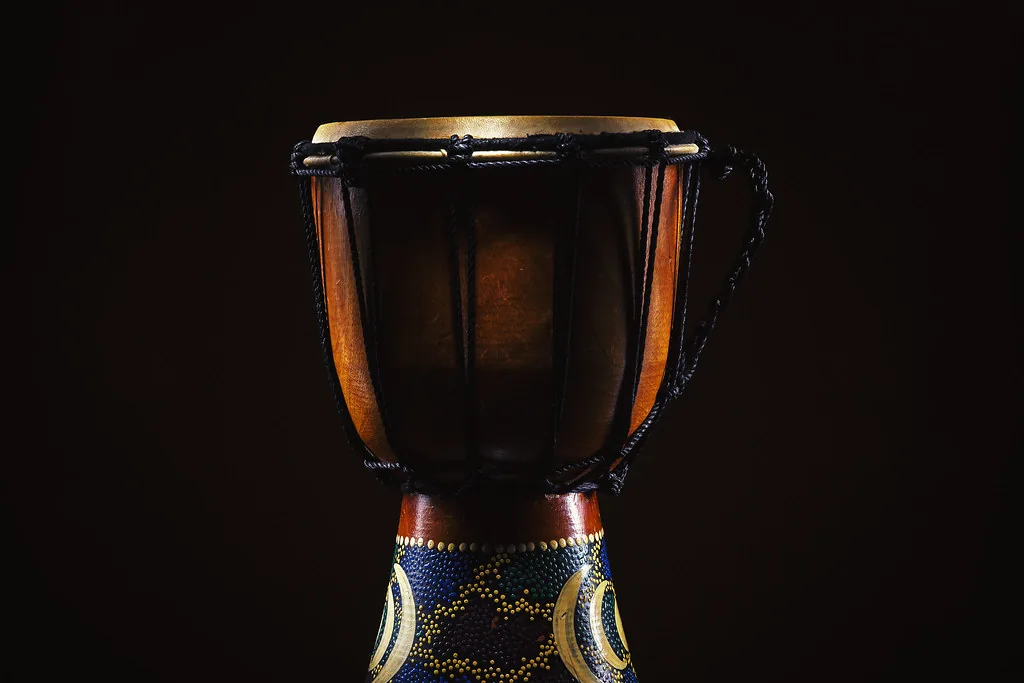
Quick introduction: this practical guide provides a clear overview for every percussionist. The author brings more than 20 years of experience in playing and making instruments, including fitting and replacing drumheads.
We explain how each type of hide influences your instrument’s sound quality. The article compares natural and synthetic heads to make your choice easier.
Goatskin remains essential for achieving an authentic sound. Here you will find simple advice for maintaining tension, limiting wear, and maximizing longevity.
For repairs and complete replacement, see our practical resource on procedures and pricing: repair or replace the drumhead.
Why your choice of drumhead is crucial for your djembe
The membrane is the main element that shapes tone and projection. Experts estimate that it defines up to 70% of the instrument’s acoustic signature.
A 0.5 mm difference in thickness noticeably changes the sound’s nuances. While a thicker head enhances bass projection, a thin head provides clearer resonance for contemporary styles.
“A slap on a thin head cuts through the mix, while a bass note on a thick head envelops the listener.”
- Tension: directly affects tuning and dynamics.
- Options: different heads let you tailor the foundation of the sound to your preferences and budget.
- Price: it often reflects the membrane’s quality and adaptability.
| Characteristic | Thin head | Thick head |
|---|---|---|
| Projection | Clear, cutting | Powerful bass |
| Resonance | Distinct harmonics | Warmth and roundness |
| Recommended style | Contemporary, solo | Ensemble, deep bass |
Goatskin djembe: benefits and care
The choice of covering profoundly changes the instrument’s acoustic response. You should assess its effect on resonance, warmth, and projection before selecting a particular type.
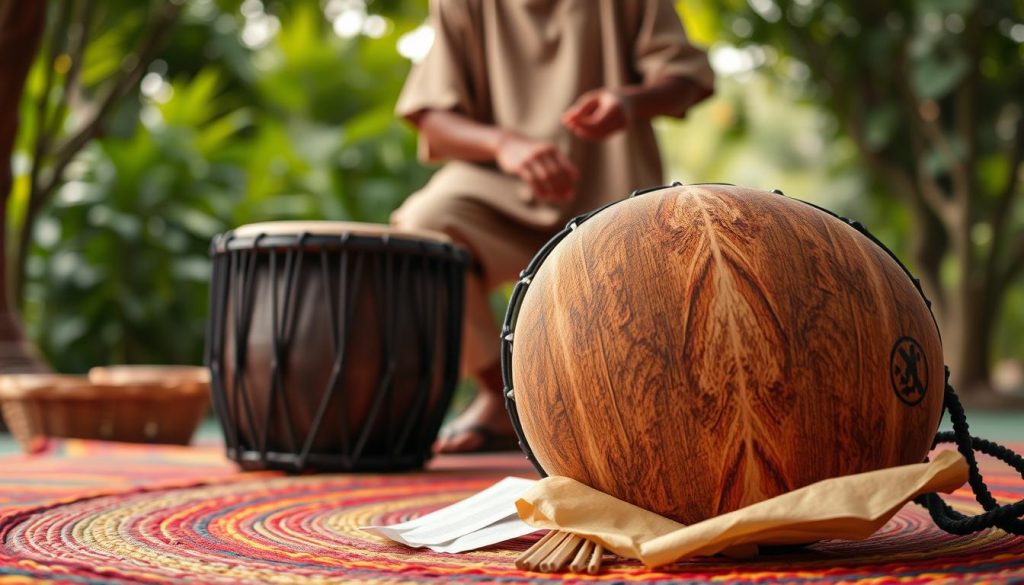
Acoustic characteristics
The hide is generally between 0.5 and 1 mm thick. This thinness produces a lively response to each stroke.
The result: crisp slaps and precise bass notes. The membrane reveals subtle nuances in traditional rhythms.
Versatility and playability
This article explains why percussionists favor this choice. With suitable tension, the sound quality remains stable.
Its versatility will help your instrument last a long time if you limit the use of chemicals.
“A well-tensioned membrane responds immediately, whatever the style being played.”
- Responsiveness: excellent for fast techniques.
- Warmth: a rich, natural tone.
- Nuance: ideal for Manding repertoire.
| Characteristic | Effect | Practical advice |
|---|---|---|
| Thickness (0.5–1 mm) | Fast response, clear harmonics | Use moderate tension |
| Tension | Stable tuning | Check the rope system regularly |
| Service life | Long with gentle care | Avoid chemicals and store it in a sheltered place |
For repairs or a complete replacement, see our guide on how to repair or replace the drumhead.
Comparing animal membranes for percussion instruments
Animal membranes have very different characteristics that directly affect instrument projection and longevity. Your choice affects resonance, warmth, and performance in humid conditions.
The durability of cowhide
Cowhide: at approximately 2 mm thick, it offers excellent strength. Ideal for outdoor performances, it provides powerful projection and extends the instrument’s life.
Deerskin: at approximately 1.2 mm thick, it prioritizes responsiveness and nuance. It suits solos and jazz styles where subtlety is paramount.
- Rare antelope hide produces unique harmonic richness but raises ethical questions.
- The tension of the ropes must suit the membrane type to maintain consistent quality.
- Budget and intended use guide your choice: durability for outdoor playing, subtlety for solos.
“A durable membrane ensures consistent performance, while a thin membrane reveals more nuance.”
To explore other options and better compare drumheads, read our article on types of drumhead.
The synthetic drumhead alternative
Synthetic membranes provide a stable alternative for percussionists who travel frequently.
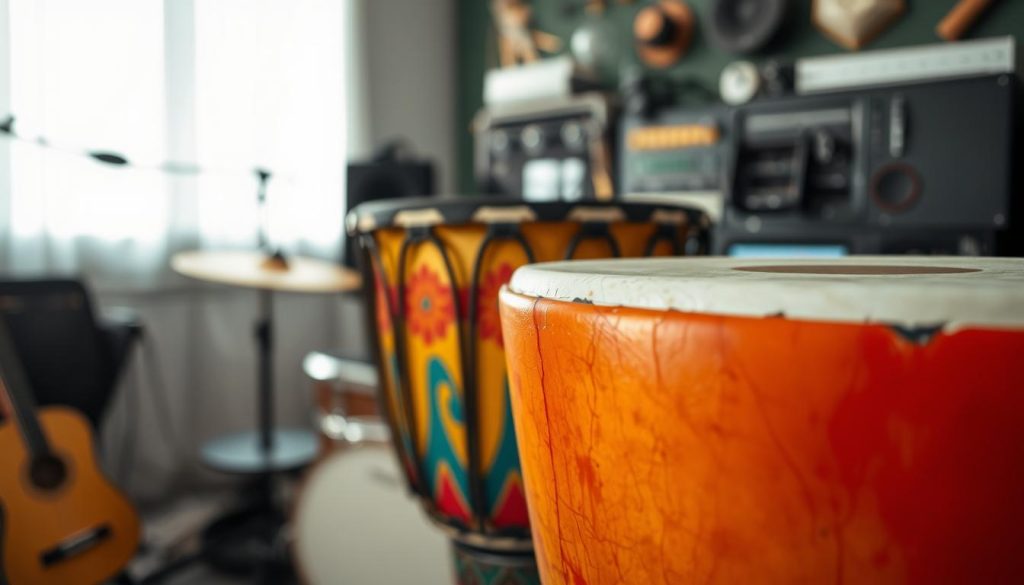
Brands such as Remo WeatherKing and Evans Hydraulic have developed patented membranes. These options can last up to three times longer than natural membranes.
Their main advantage is their resistance to climatic conditions. They maintain consistent tension, which is useful for tours and outdoor performances.
- High durability for a longer service life.
- Consistent performance despite changes in temperature or humidity.
- Often affordably priced for musicians on the move.
However, some players feel that synthetic heads have an adverse impact on harmonic richness compared with goatskin. Their resonance characteristics differ, and their tone can seem more uniform.
“A synthetic head provides stability, while a natural head preserves the full harmonic palette.”
| Criterion | Synthetic | Natural (example) |
|---|---|---|
| Durability | Very high (×3) | Moderate |
| Climate sensitivity | Low | High |
| Harmonic richness | Uniform | Rich, nuanced |
| Price | Affordable | Variable |
The choice remains personal and depends on your technique and style. To help you choose an instrument by size, see our size guide.
Techniques for preserving your instrument’s sound quality
Simple daily habits are enough to maintain a consistent sound. These routines protect the membrane, shell, and tensioning system.
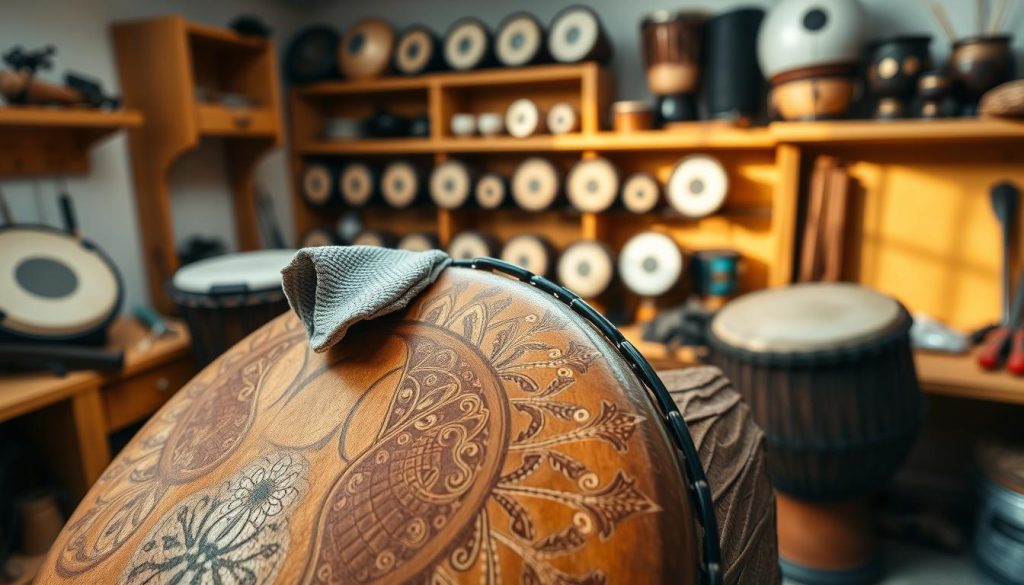
Regular cleaning
After every session, wipe the surface with a dry cloth to remove dust and perspiration. This is the best way to preserve sound quality.
Humidity management
Managing humidity prevents the head from slackening or shrinking. Sheltered storage away from sources of moisture extends your instrument’s life.
“Stable humidity protects tuning and the quality of each attack.”
Caring for the wooden shell
Condition the wood with linseed oil or shea butter once a year—or every two years—to prevent cracks.
When replacing the membrane, treat the surface carefully to avoid leaving any residue on the shell.
- Retighten the ropes every 50 hours of playing to maintain optimal tension without damaging the membrane.
- Do not apply grease to the hide: it irreversibly increases its elasticity.
| Action | Frequency | Effect |
|---|---|---|
| Dry cleaning | After every use | Preserves sound quality |
| Retightening the ropes | Every 50 hours of playing | Maintains tension and tuning |
| Conditioning the shell | Every 1–2 years | Prevents cracks and extends its life |
| Humidity control | Regularly | Protects the membrane and wood |
By following this schedule, you will ensure consistent performance and protect your instrument from the effects of time.
Practical advice for transport and protection
Protecting your instrument while traveling begins with simple but precise steps. Always pack it carefully: a sturdy case reduces impacts and scratches on its surface.
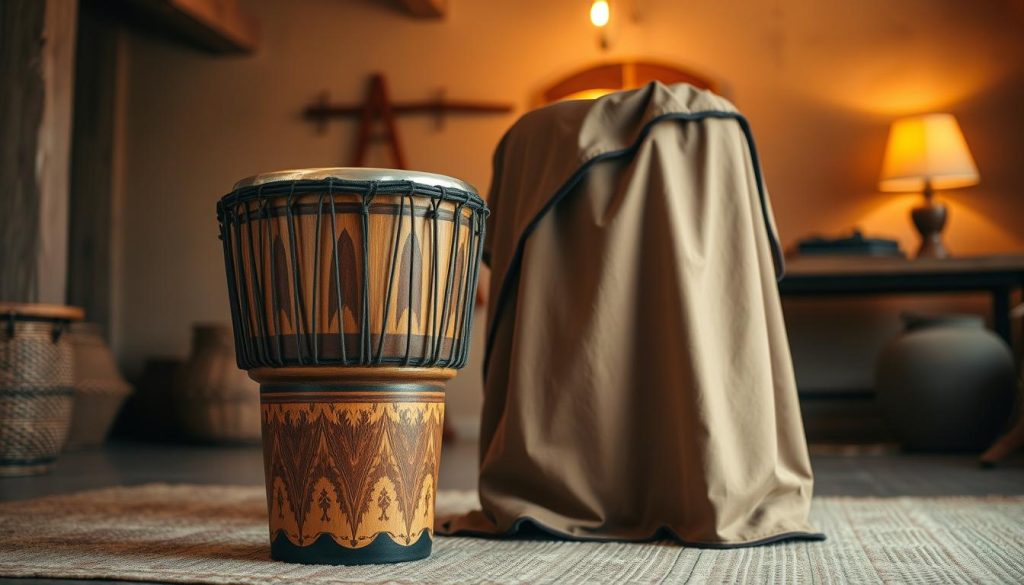
Maintain humidity at 50% in winter with a humidifier. This prevents cracks and preserves rope tension.
- Wrap the instrument in a blanket or use a thick case to cushion impacts.
- Always carry the djembe by its base so that you do not pull on the ropes or weaken the head.
- If you do not have a bag, protect it from harsh conditions with strong straps.
On a hard surface, place a circle of carpet under the base to prevent rapid wear. Taking the time to pack the instrument properly ensures greater longevity and consistent quality.
“Good protection from the outset prevents costly repairs later.”
| Action | Why | Frequency |
|---|---|---|
| High-quality protective case | Protects the surface and shell | Whenever it is transported |
| Humidity control (50%) | Preserves tension and the membrane | Regularly in winter |
| Carry it by the base | Avoids straining the ropes | Whenever it is handled |
| Base protection (carpet) | Limits abrasion on hard floors | During rehearsals and concerts |
To choose a reliable case, see our beginner’s guide. A good choice protects your instrument’s service life and maintains its quality over time.
Conclusion
Let us conclude this guide with the practical steps that preserve tuning and projection.
This short article explains that your choice of drumhead influences resonance, warmth, and responsiveness. By adjusting the tension and providing simple care, your instrument will retain its sound quality.
For both solos and group performances, compare the options according to your budget and desired style. A high-quality goatskin offers rich nuances, while other heads provide different kinds of stability.
Follow this advice to enjoy your djembe and its natural projection for years to come.