

You want to achieve a rich, precise sound from your djembe. As a player who owns more than ten instruments, I am sharing simple methods for properly maintaining and tuning your percussion instrument.
This short guide covers the essential steps: preparation, using a lever or tensioning tool, and finishing with tension knots. These techniques ensure even tension and a balanced sound suited to African percussion.
Before tuning your instrument, place the African drum on a stable support and warm up the head by playing gently for a few minutes. Then follow the tuning steps and test the tension by pinching the surface to achieve deep bass notes and crisp high notes.
For detailed instructions and step-by-step photos, see this practical guide: complete tuning method.
Preparing the Instrument Before Tuning
Stabilize the instrument: begin by placing the djembe securely on a stable support. This allows you to apply even tension to the head and prevents twisting during adjustment.
Check the environment: temperature and humidity affect the head. Avoid drafts and sudden changes, which can quickly alter the sound.
Positioning and Environmental Checks
- Make sure the drum is protected from drafts.
- Inspect every rope and the head for signs of wear.
- Since the 1970s, Quebec craftspeople have recommended keeping the instrument in good condition to preserve its quality.
Why Warming Up the Head Matters
Play gently for a few minutes to warm up the head. This relaxes the fibers and prepares the membrane to withstand progressively increasing tension.
| Action | Purpose | Frequency |
|---|---|---|
| Stabilize the djembe | Even tension | Before each tuning |
| Check temperature and humidity | Sound quality | Regularly |
| Warm it up by playing | Prepare the head | 2 to 5 minutes |
To follow a complete tuning method, work gradually and evenly.
How Do You Tighten a Djembe Head?
Position your instrument on a stable support and proceed step by step. Increase the tension in small increments to avoid overstressing the head.
To achieve an excellent sound, make sure the djembe head has even tension. Uneven tension produces indistinct notes and reduces sound quality.
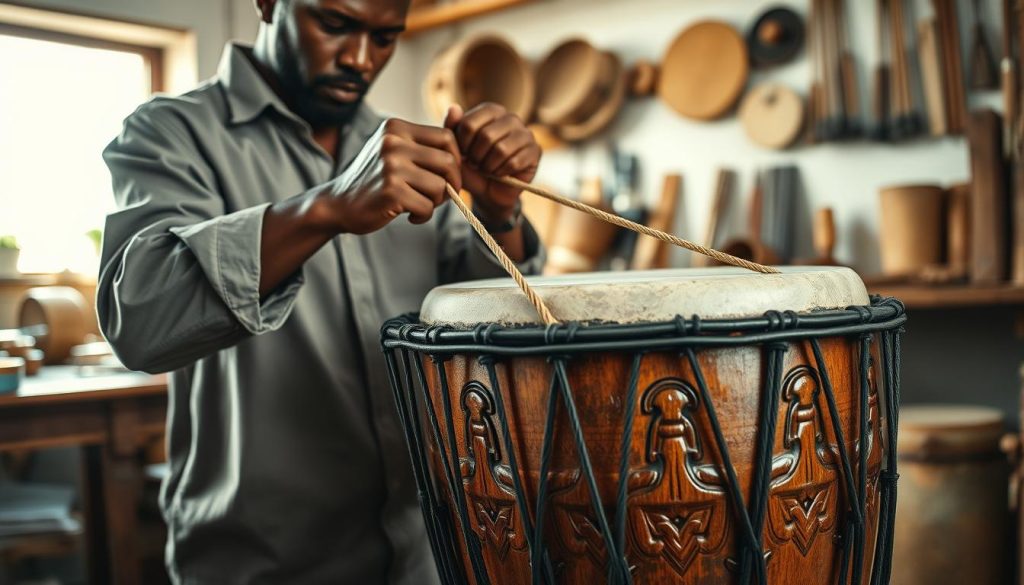
Monitor the temperature and humidity: moisture softens the head and requires more adjustments. The room climate directly affects how well the drumhead retains its tension.
- Check each rope: adjust them one at a time to distribute the tension.
- Patience: let the head settle for a few minutes between each series of adjustments.
- Precision: avoid pulling too quickly so that you do not damage the drum’s structure.
If you would like a step-by-step guide to tuning a djembe, follow the complete tuning method. These simple steps will help you keep your djembe in excellent condition and achieve a balanced sound.
Using the Lever Technique
Before you begin, make sure you have a sturdy support and a clear workspace. This precaution protects the instrument and makes precise tension adjustment easier.
Safety Precautions When Applying Tension
Choose the right lever: for the pivot technique, select a handle 55 cm long and 4 cm in diameter. For the fulcrum technique, use a lever 90 cm to 1 meter long and 3 cm in diameter.
Make sure every rope is correctly positioned against the djembe head. This prevents slipping and protects the head while you pull.
- Whenever you adjust the tension, check that the base of the djembe is secure.
- Apply tension gradually to avoid damaging the drumhead.
- Use high-quality ropes to maintain consistent djembe tension and good sound quality.
| Technique | Lever Dimensions | Benefit | Precaution |
|---|---|---|---|
| Pivot | 55 cm × 4 cm | Even tension and precise control | Position each rope against the head |
| Fulcrum | 90 to 100 cm × 3 cm | Distributes force across the base | Check the stability of the djembe’s base |
| General | — | Protects the drum and improves its sound | Work gradually and use quality ropes |
Creating Tension Knots to Adjust the Head
First check the condition of the ropes, then begin creating the knots to fine-tune the tension. Pay particular attention to this step: an improperly tied knot will cause the head to loosen quickly.
Place each knot as low as possible, near the base, to maximize its effect on the djembe’s tension. Crossing the ropes progressively increases the tension of the head and playing surface.
Tighten each rope carefully. Even tightening distributes the tension uniformly across the entire head.
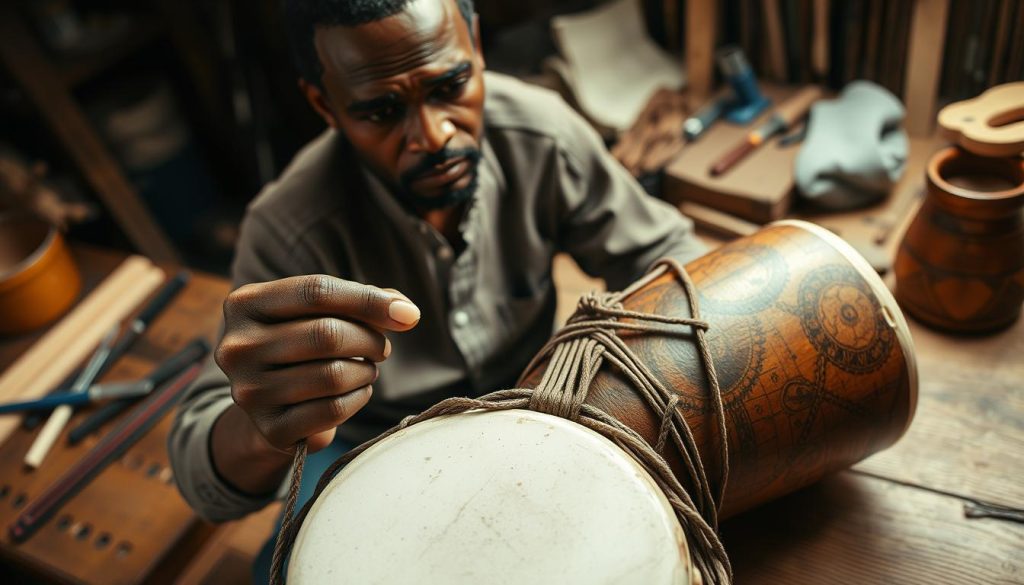
Interweaving the djembe ropes creates additional pressure that helps improve the instrument’s sound quality. After tying the knots, give the head time to settle, then check its tension regularly.
| Step | Action | Expected Result |
|---|---|---|
| Inspection | Check the ropes and head | Prevent slipping |
| Positioning | Tie the knots near the base | More effective tensioning |
| Interweaving | Cross the ropes | Increased tension and a richer sound |
| Checking | Check and retighten if necessary | Long-term stability and quality |
Making a Custom Tensioning Tool
Making a suitable lever begins with choosing strong, thoroughly dried wood. A good tool protects the head and makes it easier to tension the djembe without excessive effort.
Materials Needed for an Effective Lever
Choose a hardwood stick 60 cm long and 3 to 5 cm in diameter. This size provides enough torque to increase tension without applying excessive strain.
Make sure the end is thoroughly polished so that it slides under the rope without damaging the djembe head.
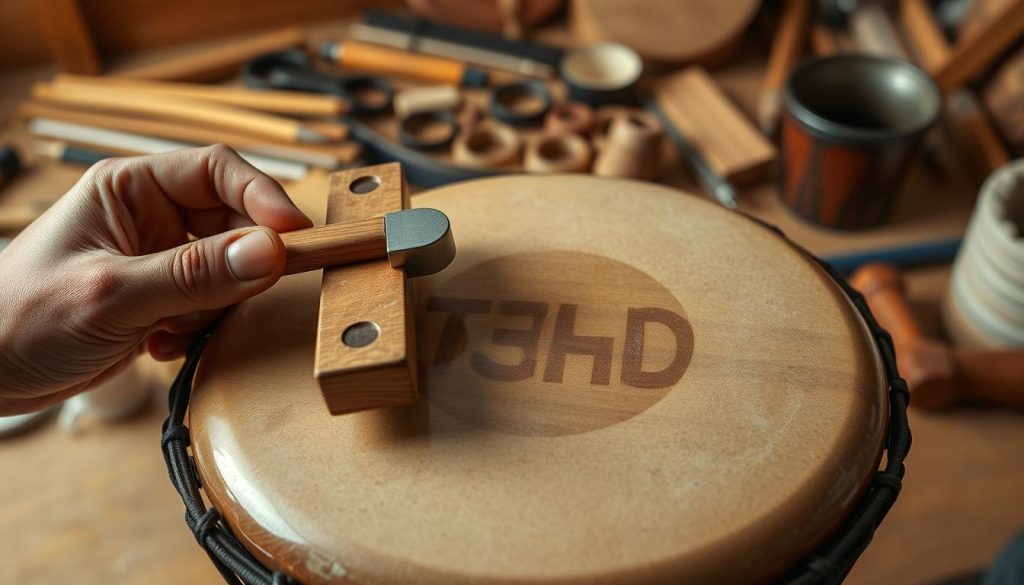
Advantages and Limitations of Homemade Tools
A custom lever helps keep the djembe in good condition and allows precise tension adjustment.
However, a professional tool may provide better sound quality and more stable djembe tension over the long term.
“A well-designed tool applies even tension to the drumhead and preserves its wooden structure.”
- A simple design makes it possible to adjust the ropes and head safely.
- Use caution: avoid sudden movements that could damage the head or drum.
- If in doubt, consult a professional to protect your instrument.
| Feature | Recommendation | Benefit |
|---|---|---|
| Length | 60 cm | Balanced leverage |
| Diameter | 3 to 5 cm | Secure grip without pinching the rope |
| Finish | Polished end | Protects the djembe head |
Methods for Checking Head Tension
Test the tension by pressing gently in the center of the head: your thumb should sink only a few millimeters. This tactile test is simple and reliable.
Listen to the sound by striking near the edge and then in the center. A properly tuned djembe produces deep bass notes and clear high notes across the entire surface.
Mamady Keïta, a leading figure in African percussion, often adjusts the tension to suit his playing and achieve a precise sound.
- Perform the flex test: pinch the head to feel its resistance.
- Check the ropes if the head responds unevenly.
- Carry out regular checks to preserve quality over time.
| Check | What to Check | Indicator |
|---|---|---|
| Center pressure | How far the thumb sinks | 2 to 4 mm |
| Listening test | Bass and high notes | Balanced sound |
| Flex test | Head resistance | Flexible but firm |
For a step-by-step procedure, see the complete method.
Replacing or Adding Ropes to the Drum
To replace or add ropes, begin by choosing a length and quality suited to the type of instrument.
Prepare the base and place the instrument on a stable support. For a standard-size djembe, allow approximately 6 meters of rope for a complete replacement. This length is essential for restoring the correct djembe tension.
Install each rope carefully. Make sure every knot is neat and tight: the quality of the rope directly affects your musical instrument’s sound quality.
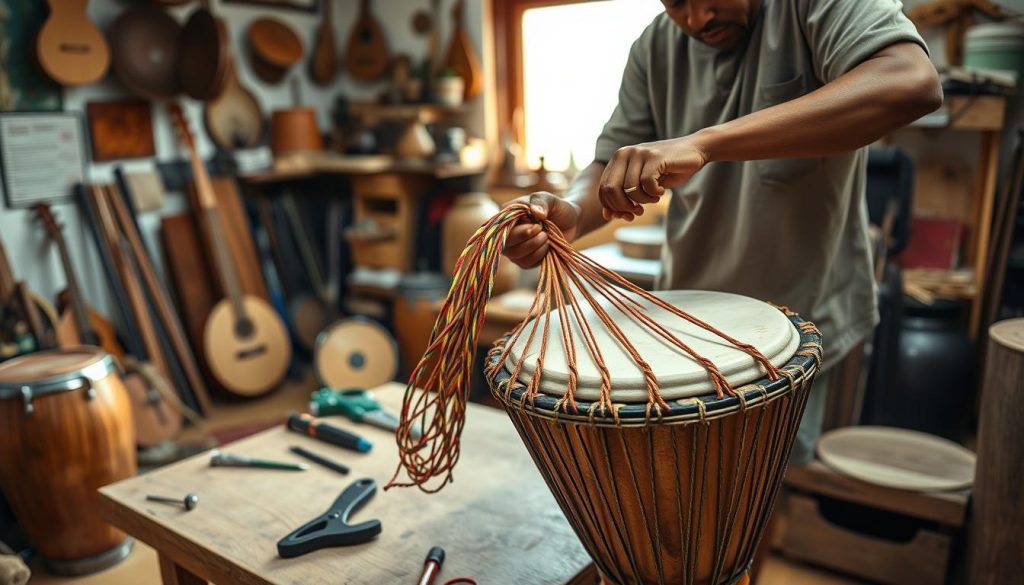
Joining-Knot Techniques for the Ropes
- Reproduce the original pattern to distribute tension across the head.
- Cut and lightly melt the ends of synthetic rope to prevent fraying.
- Whenever you replace the djembe ropes, check the condition of the base to prevent damage.
- After installation, tune the djembe gradually: adjust each rope in small increments.
| Feature | Recommendation | Effect |
|---|---|---|
| Length | Approximately 6 m | Sufficient drumhead tension |
| Rope type | Polypropylene or strong hemp | Durability and tuning stability |
| Knot | Stopper knot and two half hitches | Secure attachment and maintained tension |
Mastering knots is a key skill for any percussionist who wants to maintain an instrument independently. For a step-by-step tutorial, see this detailed ropework guide.
Tips for Preserving Tension and Longevity
Protect your instrument from changes in climate to maintain stable tension and good sound quality. A high-quality protective case limits exposure to humidity and temperature changes that loosen the head.
Treat the wood of the djembe’s base with linseed oil once or twice a year. This prevents cracks and extends the life of the wood.
After each session, clean the surface of the head with a dry cloth. This simple step preserves the surface and helps it retain tension.
Avoid prolonged exposure to sunlight and sudden temperature changes. These changes accelerate the loosening of the drumhead and fatigue the ropes.
- Check the tension regularly according to the type of head and as time passes.
- Do not overstretch the head, as this increases the risk of cracking.
- Use a case to keep the djembe in good condition between uses.
“Protecting the head and wood is essential to preserving your instrument’s sound and service life.”
Following these steps will help you maintain your drum properly and ensure stable sound over the long term.
Conclusion
Sound quality depends above all on even, well-distributed tension.
You have learned in this article that mastering tension is the cornerstone of achieving the perfect sound.
By paying particular attention to rope maintenance and the environment, you extend the life of your instrument and preserve its rich sound.
We hope you will learn to apply these techniques confidently and adapt the tuning to your playing.
Consistency and suitable tools enable you to tune and protect your treasured drum independently. For a detailed guide and step-by-step instructions, see the complete method.