

Brief introduction: This article presents the history and life of a traditional drum born more than 700 years ago in the heart of Mali. The text is intended for readers in France who want to understand this instrument of percussion and its place in ritual and popular music.
We will explain how a goatskin head, stretched over a wooden shell, produces a variety of timbres. You will also discover its social and ceremonial uses, from Manding ensembles to international stages.
To learn more, consult this detailed guide covering its history and techniques: Complete introduction to the djembe.
This guide will take you step by step through the uses, construction and playing styles that make this instrument unique.
African djembe: origin, sound and distinctive features
For centuries, this instrument has marked the major events of Manding community life.
Its shape resembles that of a pounding mortar: its flared body helps project sound during celebrations and gatherings.
The combination of wood, skin and iron makes it a symbolic object. This balance brings the plant, animal and mineral worlds together in a single musical gesture.
The shell, often carved from a single piece of wood, provides rich, deep resonance. This design ensures highly faithful timbres and excellent durability.
Among Manding musicians, this instrument is also sacred. It is used to convey emotions, messages and stories through complex rhythms.
Versatile, it can produce bass notes, slaps and melodic phrases, making it highly expressive both on stage and during ceremonies.
To explore its history and techniques in greater depth, consult this detailed guide.
History and legends surrounding the birth of the drum
The stories surrounding the birth of the drum blend history, myths and craftsmanship. Around the 13th century, the Manding Empire founded by Soundiata Keïta provided fertile cultural ground for the emergence of new instruments.
Manding roots
The Malinke and Bambara peoples repurposed wooden mortars to create the earliest form of the shell. This practice demonstrated how an everyday object could become a musical instrument during ceremonies.
Myths and oral traditions
Tradition holds that a village woman stretched a skin over a hollowed-out mortar, thereby creating the first drum. Blacksmiths performed rituals before carving the wood, seeking the blessing of the tree spirits.
“Every finger striking the skin perpetuates a bond between the living and their ancestors.”
The legend of the “gebraffe” illustrates the richness of these myths. Griots, the guardians of traditions, ensured that this knowledge was passed down, and the instrument ultimately conquered the world.
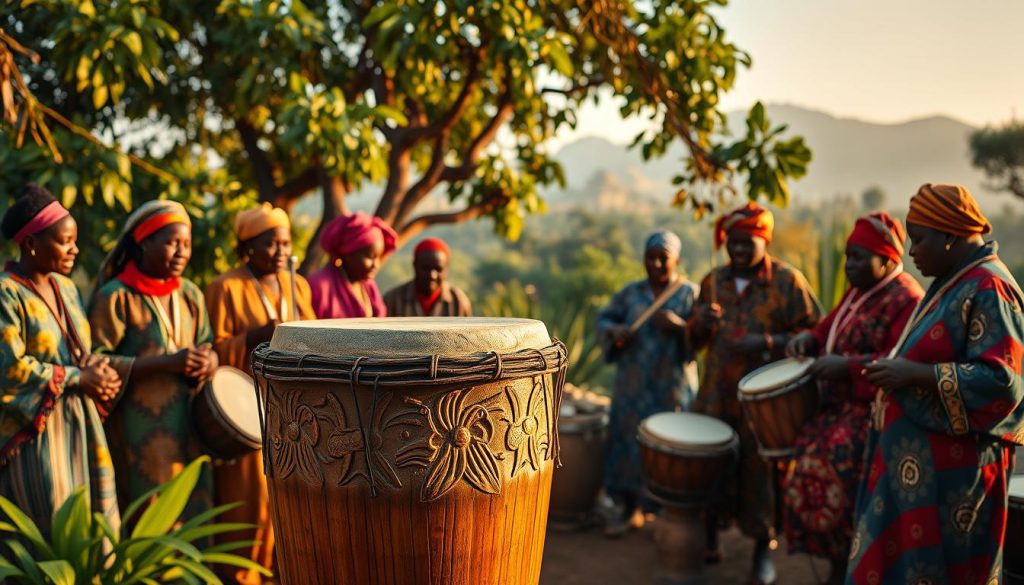
For a technical comparison with other percussion instruments, consult this comparison guide.
Anatomy and construction materials
Every carved piece of wood and every fitted skin reflects ancestral expertise.
The role of wood and skin
Craftspeople select dense woods such as mahogany, lingue, dugura or gueni. These species give the shell warmth and power. Its chalice shape helps project the sound.
Finely shaved goatskin hide remains the standard because of its resonance. It is stretched using ropes made of nylon, which provide stable tension. The force applied while weaving the ropes adjusts the pitch.
The surface of the skin must be perfectly circular. This distributes pressure evenly beneath the percussionist’s fingers. Wrapped iron hoops protect the edge and hold the skin in place.
- The shell is hollowed out of a single trunk for optimal sound.
- Each type of wood affects the depth of the timbre.
- Nylon ropes allow precise manual adjustment of the tension.
| Component | Material | Effect on sound |
|---|---|---|
| Shell | Mahogany, lingue, dugura, gueni | Richness, projection, warmth |
| Head | Goatskin | Clarity, resonance |
| Fastening | Nylon ropes, iron hoops | Stable tension, durability |
To learn more about making and maintaining this instrument, consult this detailed guide.
Mastering striking techniques and sounds
Mastering the strokes transforms the drumhead into a precise rhythmic language.
The four basic strokes—piano, slap, open tone and muted bass—form the foundation of striking technique. The piano stroke, played near the rim, maintains a continuous flow. The slap produces a sharp, percussive sound. The open tone, struck one-third of the way in from the rim, produces balanced resonance. The muted bass, played in the center, suppresses unwanted vibrations to produce a dry low note.
Position is essential: sitting with the instrument between the legs and the body upright preserves both stability and freedom of movement. Djembefolas combine the palm and fingers to vary nuance and dynamics, from piano to fortissimo.
Drumhead tension, striking angle and force alter the vibrations and enable rich solos. Take care with the volume: this instrument can exceed 105 decibels, louder than a lawn mower.
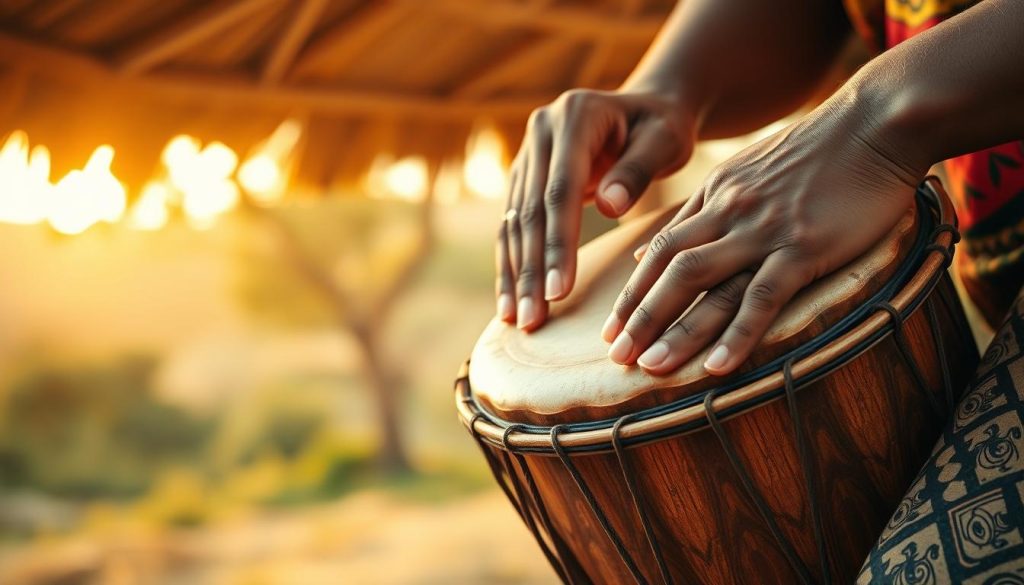
To explore these techniques in greater depth and make rapid progress, consult this practical guide: techniques and useful advice.
Global expansion and cultural influence
During the second half of the 20th century, the world stage discovered a rhythm from West Africa through touring ballet companies.

Fodéba Keïta played a decisive role by bringing these rhythms to Europe from the 1950s onward. His performances introduced Western audiences to the instrument and paved the way for cultural exchange.
In the 1980s, masters such as Famoudou Konaté established teaching centers in Europe and Japan. They trained local percussionists and popularized both solo and ensemble playing.
Manding polyrhythm inspired modern music. It can now be heard in pop-rock, fusion and electric compositions. This movement demonstrated that traditions can adapt without losing their integrity.
“Rhythm unites people and builds bridges between tradition and innovation.”
To explore percussion and cultural exchange in greater depth, consult this feature on African percussion.
Conclusion: choosing and maintaining your instrument
Choosing an instrument begins with finding the right balance between material quality and careful finishing. Check the wood, the shape of the shell and the condition of the head to assess the maker’s workmanship.
Check the drumhead tension manually and consider the type of mounting system. Stable tuning ensures better pitch retention and safer playing.
Regular maintenance includes replacing the nylon ropes and checking the tension periodically. Practice regularly with your fingers to improve.
By following the advice in this article, you will choose a drum that honors tradition and keeps the richness of music alive throughout the world.