
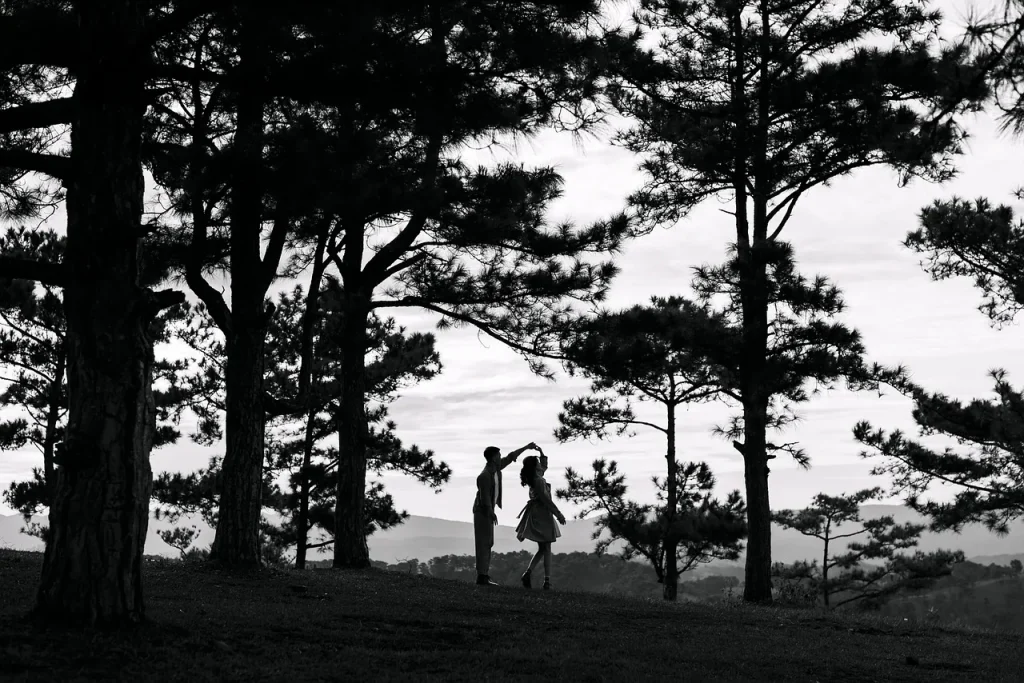
Bachata is a sensual, rhythmic dance that originated in the Dominican Republic. It is danced in pairs, with a unique connection between partners. This lively music encourages harmony and togetherness.
There are several styles: Dominican, modern, and sensual. Each brings its own touch, but they all require careful attention to timing and fluid movements. To improve, you need to avoid common mistakes such as stiffness or poor communication.
In this article, discover tips for improving your technique. Learn to lead or follow more effectively while staying connected to your partner. To explore the subject further, read our complete beginner’s guide.
The essential foundations of partner bachata
Mastering the fundamentals is crucial for a smooth experience. These elements create chemistry between the two dancers and make complex figures easier to learn.
The basic step and its characteristic rhythm
The signature movement is performed over 8 counts, with a lateral weight transfer. Count “1, 2, 3, tap” to mark the fourth count.
One effective exercise is to walk in mirror image without music. This improves synchronization and awareness of your partner.
| Count | Movement | Foot |
|---|---|---|
| 1 | Step to the left | Left |
| 2 | Transfer to the right | Right |
| 3 | Return to the left | Left |
| 4 (tap) | Light touch | Right |
The ideal posture for harmonious dancing
Keep your knees slightly bent. This position absorbs movement and provides greater stability.
Adjust the distance according to the other person’s height. Too little space restricts freedom, while too much distance breaks the connection.
The importance of contact and connection
The leader places their right hand on the right shoulder blade. This area allows precise guidance without stiffness.
Avoid protruding jewelry. It can get in the way and reduce the quality of contact.
“In three months, my students go from mechanical movements to genuine connection. The key? Practicing these fundamentals every day.”
Techniques for leaders: leading with precision
Leading bachata requires a combination of subtlety and confidence. The leader must communicate their intentions clearly while remaining attentive to their partner. A strong connection makes the movements natural and harmonious.

Establishing clear, fluid guidance
The “progressive leading” method works particularly well:
- Begin with gentle impulses from the palm
- Gradually increase the pressure if necessary
- Avoid sudden gestures that disrupt balance
Five common mistakes to know:
- Gripping hands too tightly
- Forgetting to prepare turns
- Leading with the arms rather than the body
- Neglecting weight transfer
- Anticipating instead of following the rhythm
Signals for different figures
Each technique requires specific cues:
- Turn: palm pressure on the right shoulder blade
- Lateral movement: hip orientation
- Pause: slight tension in the forearms
“In competition, predictable signals make all the difference. My partner always knows what to expect.”
Managing space on the dance floor
On a crowded dance floor, use these strategies:
- Move diagonally to anticipate obstacles
- Use your peripheral vision during turns
- Adjust your position according to the flow of traffic
One effective exercise is to link three different figures without interrupting the flow. This improves spatial awareness and fluidity.
Tips for followers: the art of following
Following does not mean being passive; it means collaborating with elegance. A good follower combines sensitivity and creativity to turn every cue into a harmonious dance.
Developing sensitivity to cues
The blind following technique strengthens tactile awareness. Close your eyes during an exercise to focus on signals from the body.
Shoulder isolations help you interpret the music. Synchronize these movements with the strong beats for a more intuitive connection.
Staying connected without anticipating
Avoid guessing the steps. Count backward mentally during pauses to stay in the present.
One essential quality is patience. Allow yourself to be led without resisting, even during complex figures.
“Moving from passive following to creative following transformed my dancing. Today, I dare to add waves that complement my partner’s style.”
Expressing your personal style while following
Arm waves enhance simple passes. Play with curves to express your personality.
Choose flowing outfits. A lightweight dress amplifies movement and follows the current trend.
How to dance bachata as a couple with a perfect connection
A harmonious connection turns every step into a unique experience. In this discipline, physical dialogue takes precedence over technical figures. Let us see how to cultivate this special chemistry.

The role of physical contact in communication
Touch conveys up to 80% of the information exchanged between partners. A hand placed flat on the shoulder blade provides greater precision than interlaced fingers.
The main advantage? This contact allows micro-adjustments that are invisible to the naked eye. For fast figures, slightly reduce the contact area.
Adjusting tension to suit the movements
Ideal pressure varies like musical volume. During slow passes, reduce contact to 30% of your usual strength.
For energetic turns, gradually increase it to 70%. This technique prevents jerky movements while maintaining fluidity.
“After our intensive workshop, we discovered that an additional 500 grams of pressure was enough to clarify our complex movements.”
Exercises to improve connection as a couple
Try these proven methods:
- The mirror exercise: facing each other, synchronize your weight transfers without speaking
- Synchronized breathing: inhale and exhale in unison for an entire song
- Role-playing: switch positions every 30 seconds
A microfiber towel in your back pocket is useful during long sessions. It preserves the quality of contact despite the exertion.
Musicality and interpretation as a couple
Musicality transforms every step into a silent conversation. In this discipline, understanding the rhythm allows you to create perfect harmony with your partner. Active listening then becomes your greatest asset.

Recognizing the strong beats in the music
A typical track combines several characteristic instruments:
- The güira marks the main tempo
- The bongo adds syncopated accents
- The electric bass emphasizes the strong beats
To practice, try this:
- Listen to a song with your eyes closed
- Tap your foot on every bass beat
- Count aloud “1, 2, 3, tap”
Synchronizing your movements with your partner
The subdivided-counting method works well for changes in rhythm. Mentally divide each beat into two equal parts during fast remixes.
One effective exercise:
- Practice the body roll on accented bass notes
- Maintain constant eye contact
- Gradually adjust your speed
“Songs by Prince Royce or Dani J are excellent for practice. Their clear structure helps you anticipate musical breaks.”
Playing with pauses and musical accents
Silences in the music offer creative possibilities. Use them to:
- Add a subtle body wave
- Maintain dramatic tension
- Prepare a spectacular figure
At a social, wear Alpine MusicSafe earplugs. They protect your hearing while allowing essential frequencies through.
Common mistakes and how to avoid them
Improving at bachata involves identifying common pitfalls. These mistakes, often repeated by beginners, can disrupt harmony between partners. Let us see how to correct them for smoother dancing.

Classic pitfalls for leaders
Novice leaders tend to control their partners too much. Tense shoulders are a telltale sign of this excessive tension.
Other pitfalls to know:
- Leading only with the arms instead of the body
- Neglecting preparatory signals before turns
- Holding your breath during complex figures
| Mistake | Consequence | Solution |
|---|---|---|
| Overleading | Partner discomfort | Reduce pressure to 50% |
| Poor space management | Risk of collisions | Scan the dance floor every 8 counts |
| Rigid posture | Lower-back pain | Keep the knees slightly bent |
Recurring faults among followers
Anticipation is the number-one enemy. Many people guess the steps instead of listening to the cues.
Common repetitive strain injuries:
- Wrist tendinitis (poor reception during turns)
- Neck pain (gaze held too low)
- Back muscle tightness (hunched posture)
“90% of my dancing patients experience these same problems. A simple warm-up routine effectively prevents them.”
Restoring a lost connection
When physical dialogue weakens, the reset step offers a simple solution. This four-count reset step helps you find the rhythm again.
Proven techniques:
- Mental visualization before each dance
- Maintain eye contact for three seconds
- Smile to ease the atmosphere
In the event of a collision, a nod is enough. The important thing is to restore harmony quickly.
Conclusion: growing together through bachata
Harmony in motion is cultivated day after day. Technique, attentiveness, and shared enjoyment are the pillars of a successful dance. Together, they transform every step into a unique experience.
Attend festivals to discover different styles. Intensive workshops accelerate your progress while allowing you to meet the passionate community surrounding this discipline.
Being considerate toward your partner is essential. Supplement these tips with Spotify playlists or specialized YouTube tutorials.
One final tip: record your sessions. Visual analysis reveals details that are impossible to notice while dancing.
Ready to get started? Sign up for a free introductory class near you.