
With more than 20 years of experience, the author guides you in choosing a suitable percussion instrument. This article presents the essential points for assessing quality: the origin of the wood, the type of skin and the overall size.
The playing surface directly influences the sound. Its diameter and size define the tone produced at the center or edge. Each wood species offers a distinct resonance.
The musician’s hand must find the right balance on the skin to produce a clean strike. Investing in a carefully crafted model helps preserve a rich and enduring musical tradition.
To discover options and places to buy one, read our practical guide on where to buy a djembe.
Why choose a handcrafted djembe: the benefits of an authentic instrument
A handmade instrument reveals sonic nuances that are difficult to reproduce through mass production.
Wood quality: a shell carved from a solid piece of wood provides clear, lasting resonance. Dense wood ensures natural projection, ideal for both the stage and workshops.
Richness of the skin: animal skin produces a deep tone and rich harmonics. This material responds better to variations in striking than synthetic heads do.
Supporting craftsmanship: owning an authentic instrument means supporting time-honored crafts. Each piece has a unique finish that becomes more beautiful over time.
- Solid wood for better projection.
- Natural skin for deep bass and crisp slaps.
- A unique piece whose character evolves over time.
Handcrafted djembe: why choose one?
An instrument can sound very different depending on its material and construction.
Differences between traditional and modern models
Solid-wood shells, such as mahogany or iroko, offer rich resonance and natural projection. These woods produce rounded bass at the center and precise slaps at the edge.
Modern ABS or fiberglass models prioritize low weight and durability, but they lose some tonal warmth. Their synthetic heads remain stable in humid conditions, unlike goatskin.
The impact of handcrafting
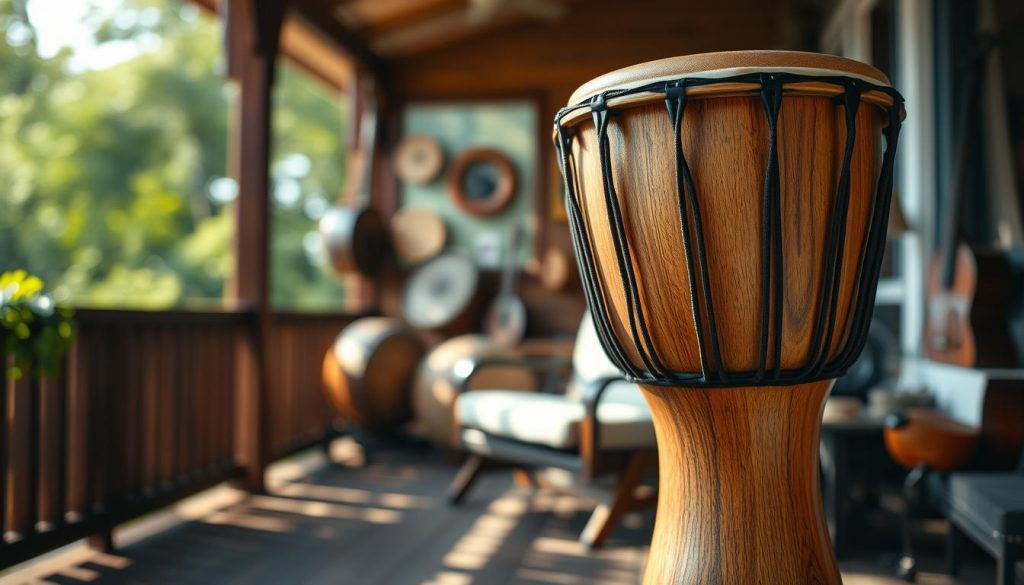
Handcrafting affects every component: properly fitted rope maintains tension and enables subtle variations in strikes between the center and the edge.
Knowledge of the rope system and skin care ensures lasting use. This type of construction perpetuates tradition and encourages the creation of instruments that evolve with use.
| Characteristic | Traditional | Modern |
|---|---|---|
| Shell material | Mahogany / Iroko | ABS / Fiberglass |
| Head | Goatskin (natural) | Synthetic head |
| Tension | Traditional, adjustable rope system | Stable mechanical system |
| Response to humidity | Variable | Little affected |
The importance of wood density in sound quality
The material’s density directly influences resonance and note duration.
Comparing African wood species
African wood species have a high density, generally ranging from 700 to 900 kg/m³. This dense wood acts like an acoustic mirror. It reflects the energy of the strike toward the skin and produces lively projection.
By contrast, soft Asian woods, with a density of 400 to 500 kg/m³, absorb some of the energy. The sound becomes duller and sustain is reduced.
- Wood of 700 to 900 kg/m³: deep bass, crisp highs and good note duration.
- Wood of 400 to 500 kg/m³: a more muted sound with less projection.
- Molecular structure: influences sustain and clarity.
| Characteristic | African species | Soft Asian woods |
|---|---|---|
| Density (kg/m³) | 700–900 | 400–500 |
| Effect on the skin | Maximum reflection and projection | Absorption and a duller sound |
| Sustain | Long, lasting notes | Short, rapid decay |
For more information about choosing a wood species, read our guide. The right material completely changes the sound of your instrument.
Choosing the ideal size for your body and goals
The size of your instrument influences both comfort and tone. For relaxed playing, its dimensions must suit your body. A poor fit creates tension in the shoulders and arms.
Medium-sized models have a diameter of between 40 and 50 centimeters. This format offers a good balance between portability and tonal richness. It is particularly suitable for intermediate musicians.
Larger instruments emphasize deep bass. Compact models favor higher notes and ease of handling.
- Comfort: adjust the height and position to preserve natural movement.
- Sound: a solid-wood shell and taut skin provide more bass on larger models.
- Testing: try several sizes before making your choice.
Setting a budget for your first percussion purchase
Setting a price range makes it easier to select a percussion instrument that meets your needs.
Entry level (€50–€100): this range is suitable for beginners. You will find a functional instrument that allows you to learn the basics without a major financial commitment.
Mid-range (€100–€300): by investing a little more, you get better wood and a more durable skin. Sound quality improves, and the instrument can accompany you as you learn.
High-end (> €300): above €300, you can access carefully crafted models, often designed for the stage. Their projection and harmonic richness are markedly superior.
- Your budget should reflect your long-term commitment.
- Good used instruments are available, but always check the condition of the shell and skin.
- Trying several instruments remains the best way to assess value for money.
For practical tips and advice on making the right choice, read our dedicated guide.
Essential accessories for protecting and maintaining your instrument
The right accessories extend your instrument’s musical life and make it easier to transport. A padded case protects it from impacts and moisture while traveling.
Case and strap: comfort and protection
A strap allows you to play longer without fatigue. It distributes the weight and makes the instrument easier to use while standing.
Choose a waterproof case and a wide strap for better support. This prevents strain on the wood and skin.
Managing tension according to humidity
Skin tension varies with humidity. In winter, the rope often needs to be tightened to preserve the desired tone.
- Allow about 30 meters of quality rope for a complete setup on a standard djembe.
- Use suitable products to care for the wood and preserve its resonance.
- Keep your hand relaxed when striking to prevent injury and optimize the sound.
Tip: check the tension before every session and put the instrument back in its case after use.
For buying and maintenance advice, read our beginner’s guide.
Technical criteria for checking a model’s authenticity
A structured inspection helps you assess an instrument before purchase. Begin with a visual inspection, then handle each component to evaluate its quality.
Inspecting the shell for cracks
Check for structural cracks: a shell carved from a single piece of wood should be uniform. Feel the surface to detect repairs or filled areas that may conceal breaks.
Checking the quality of the goatskin
The skin directly influences the strike and tonal color. Examine it for wear, perforations or thinned areas.
Test its response by striking the center and then the edge to assess its tension and responsiveness.
Analyzing the rope system
Inspect the rope: quality rope ensures precise tension adjustment around the entire circumference. Look for strong knots and even installation.
- Ask about the origin of the wood and request a CITES certificate for protected species such as rosewood.
- Check that the diameter and size are proportional to ensure a balance between the center and edge.
- Inspect the shell surface for hidden repairs that could alter the type of sound.
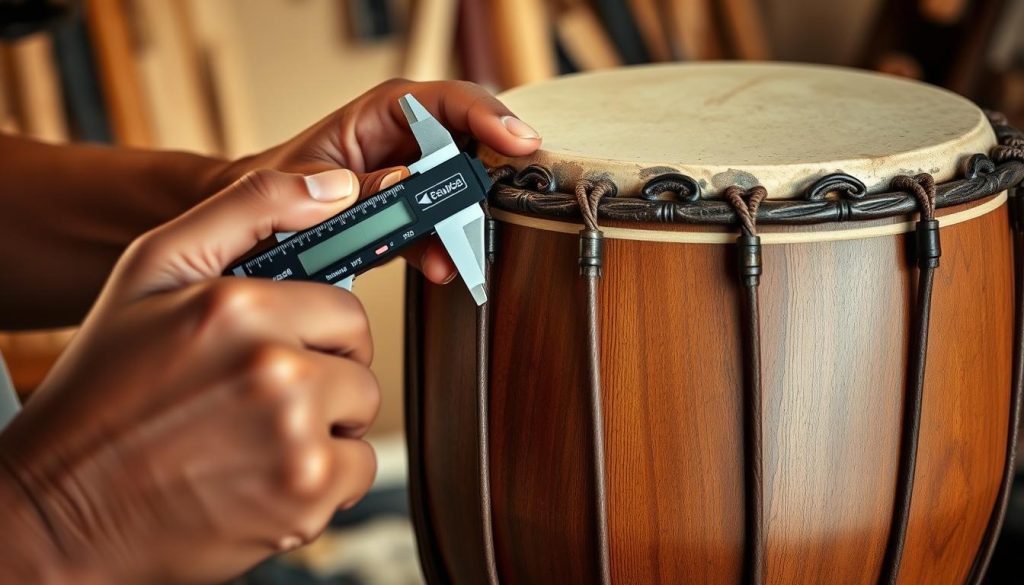
Tip: if anything seems questionable, ask for a demonstration and compare several models in a store or at an instrument maker’s workshop.
For a detailed buying guide and practical advice, read our dedicated page on how to choose an instrument according to tradition.
Conclusion
In conclusion, remember that a good instrument is born from a balance between the quality of the wood, the skin and the rope tension.
This article has shown the impact of shell density, the importance of a well-prepared skin and the role of tension in producing powerful bass and crisp slaps.
Your choice will depend on your budget, body type and commitment to percussion. Regular maintenance and suitable accessories will extend the instrument’s musical life.
To learn more about construction and adjustment, read our page about designing a traditional instrument: construction and design.