

Born in the Dominican Republic, this Latin dance has won over the world thanks to its infectious rhythm and accessibility. Easy to learn, it appeals to beginners and experienced dancers alike.
Over the years, this artistic expression has evolved, moving from working-class streets to major international stages. Today, nearly 90% of schools in France offer classes, reflecting its growing popularity.
The secret to dancing beautifully to music lies in the connection between partners. Discover how to master the fundamentals and create perfect chemistry. To learn more, read our guide to the different styles of this discipline.
Introduction to bachata for couples
Combining rhythm and connection, this Latin dance is performed as a couple. Originating in the Caribbean, it turns every movement into a silent language in which the body speaks as eloquently as the music.
For beginners, its strength lies in its simplicity. The basic step, broken down into eight counts, can be learned quickly. A real relief for anyone intimidated by complex choreography.
Group classes are ideal for making progress. They provide opportunities to practice with different partners, refining listening skills and adaptability. As an instructor at the École des Danses Latines-Tropicales confirms:
“70% of our students master the fundamentals within 10 lessons. The key? Consistency and communication.”
For practice, nothing beats classics such as Aventura’s Obsession. Its steady tempo and melodic accents make it an essential track for working on the fundamentals while expressing emotion.
Fundamental bachata positions
Mastering body placement is essential for creating fluid dynamics between partners. Each style offers unique possibilities, ranging from expressive freedom to profound intimacy.
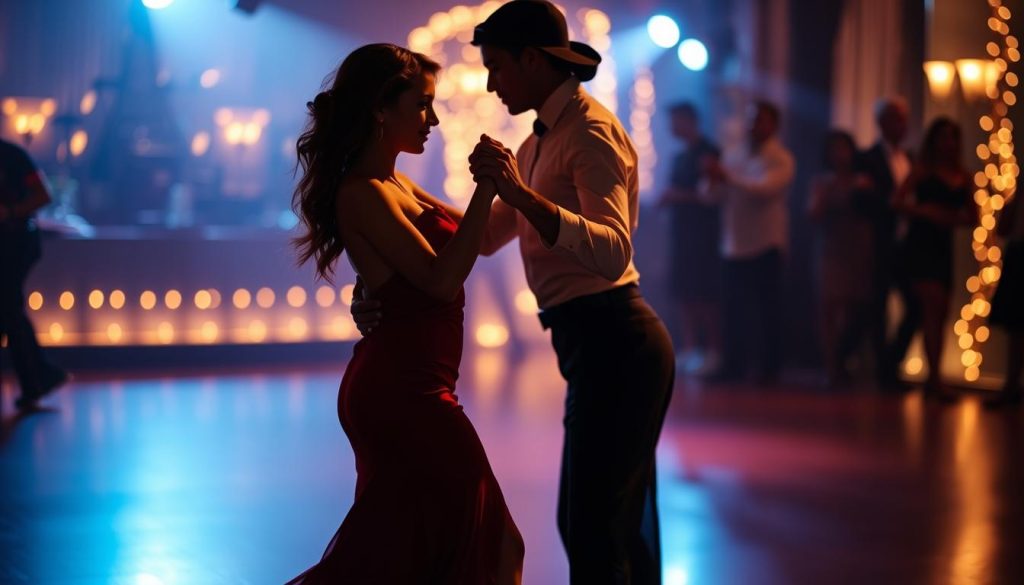
The open position: freedom and expression
Ideal for expansive movements, this position maintains a distance of about 50 cm. The hands meet without tension, allowing sweeping turns.
A 120° angle between the arms ensures precise leading. This technique is particularly useful for figures such as the turn pattern.
The closed position: intimacy and connection
Chest-to-chest contact creates natural synchronization. Aligning the knees enhances weight transfers, which are essential to the Dominican style.
As the experts demonstrate, this position encourages mutual awareness through subtle bodily signals.
Creative variations
The offset position enables sophisticated weight play. In the “shadow position,” the lead is communicated mainly through the hips.
| Position | Distance | Point of contact | Use |
|---|---|---|---|
| Open | 50 cm | Hands | Sweeping figures |
| Closed | Full contact | Chest | Footwork |
| Offset | 30 cm | Hips | Weight transfers |
Alternating these positions every 16 counts adds rhythm. Champions Marius & Elena use this principle in their most complex choreography.
Contact techniques for a harmonious connection
A successful partnership depends above all on the quality of the physical communication. The connection between partners is cultivated through precise methods that turn every movement into a dialogue.
The role of leading and listening
The “frame,” or upper-body structure, serves as an anchor. Light pressure of less than 500 g through the hands provides clear leading without tension.
An effective exercise? Dance with your eyes closed. This sharpens your perception of subtle bodily signals and strengthens mutual trust.
Managing tension and sensuality
Synchronized breathing makes transitions smoother. As champion Carlos Robles explains:
“Technique should follow the rhythm, not the other way around. A distance of 30 cm allows just as much expression as close contact.”
Unlike salsa, bachata favors more sustained contact, creating a unique harmony. Eighty percent of mistakes stem from misinterpreting these nuances.
Musicality in bachata: dancing with the rhythm
Musicality turns every step into a dialogue with the melody. Instruments such as maracas and the güira shape the rhythm, providing clear reference points for synchronizing movements.
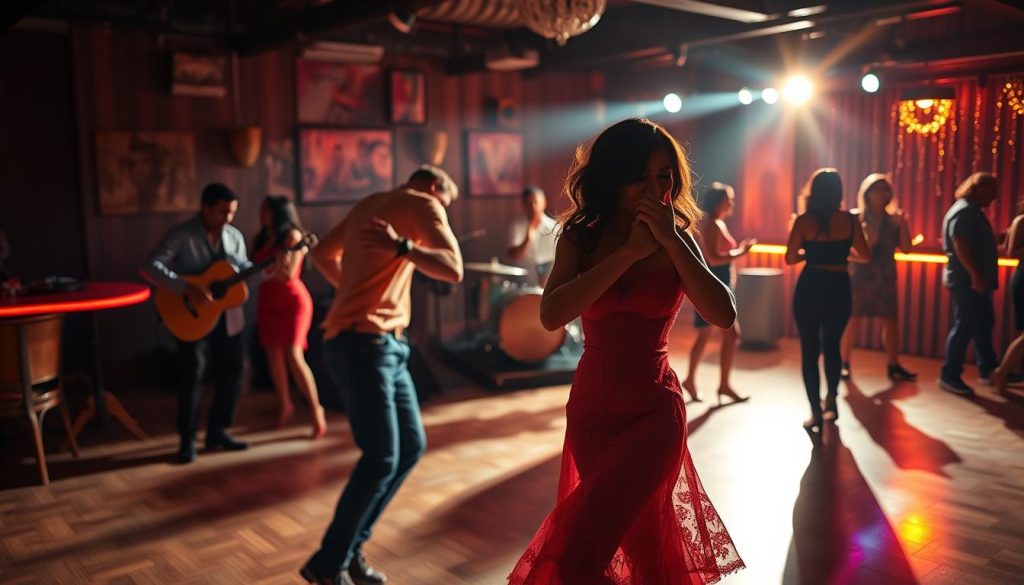
Identifying the accented counts (4 and 8)
Counts 4 and 8 are pivotal. A simple exercise is to clap on these accents to internalize the structure. This improves the fluidity of transitions.
Juan Luis Guerra’s Bachata en Fukuoka illustrates this dynamic perfectly. Its melodic pauses invite dramatic stops, making it ideal for developing expression.
Expressing the music’s emotions
Body isolations help emphasize subtle nuances. The shoulders and hips respond to the accents, creating a visual emotion.
Key comparison:
| Style | Characteristic | Average tempo |
|---|---|---|
| Dominican | Lively footwork | 110-130 BPM |
| Modern | Fluid movements | 120 BPM |
To go further, acting out the lyrics with your body adds a narrative dimension. As artist José Manuel Calderón says:
“The music must pass through your bones before reaching your feet.”
Practical exercises to improve your dancing
To progress quickly, certain exercises are indispensable. They reinforce the fundamentals while developing rapport between partners. Here are methods proven by professionals.
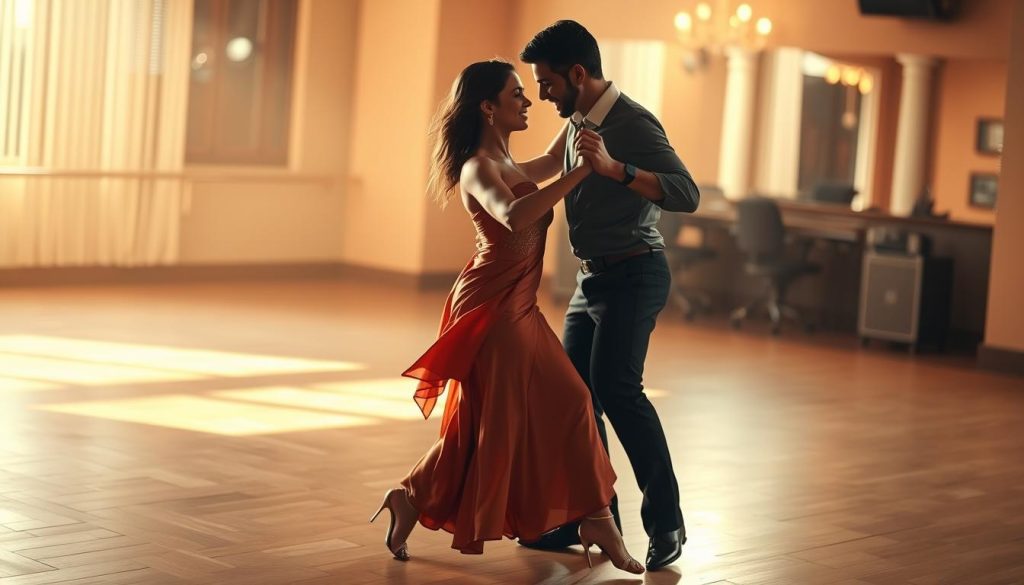
Partner basic-step drills
Practicing for 20 minutes a day with a metronome improves precision. Start slowly (90 BPM), then increase the tempo gradually.
The “mirror game” is a classic:
- Alternate the leader and follower roles
- Mirror the movements without speaking
- Practice weight transfers
The synchronized body roll method improves coordination. One effective example is to perform three consecutive hip rotations on counts 4, 5, and 6.
Nonverbal connection games
The backward-fall exercise builds trust. One partner must catch the other gently, with their hands placed at shoulder-blade level.
Recommended activity: improvise to Propuesta Indecente. This track offers ideal pauses for testing responsiveness.
| Exercise | Duration | Benefit |
|---|---|---|
| Basic step with a metronome | 20 min/day | Rhythmic precision |
| Mirror game | 10 min | Mutual awareness |
| Synchronized body roll | 5 repetitions | Coordination |
As Sophie, a student for three months, recounts:
“These exercises have transformed my technique. My partner and I become more fluid every week.”
Recommended equipment: shoes with pivot-friendly soles to make turns easier. Experienced dancers consider them essential.
Conclusion: the chemistry of bachata for two
Harmony between partners grows out of practice and mutual awareness. This discipline combines bodily expression with rapport, creating a unique connection.
Festivals such as Bachata Day Italy and Paris Sensual Week provide spaces for sharing and connection. Since 2020, schools have recorded a 40% rise in enrollment, demonstrating its growing popularity.
As a Dominican master puts it: “It is poetry of the hips”. Letting the music guide your movements creates natural fluidity.
Join our free introductory workshop to experience it for yourself. Share your own story on social media with #DanceInHarmony.